What is Brugada syndrome?
Clear and accessible information to help individuals and families better understand Brugada syndrome, possible warning signs, diagnosis and management.
Understand the condition
What is Brugada Syndrome?
An electrical fault in a structurally normal heart
Brugada syndrome is an inherited heart rhythm condition. The heart is usually formed perfectly normally, scans come back clear, but the electrical signals that coordinate each beat can become unstable.
- Every heartbeat depends on charged particles, principally sodium, moving through microscopic channels in the heart's cells.
- In Brugada syndrome one or more of those channels does not work correctly.
- Around one in five cases is traced to a change in the SCN5A gene.
- It is inherited: a parent who carries it has a one in two chance of passing it to each child.
- Risk varies widely. Many people who carry the pattern never experience a dangerous rhythm.
Possible signs and symptoms
Most people with Brugada syndrome have no symptoms at all, and it is often found through family screening. Where symptoms do appear they are easily mistaken for something more ordinary, which is why they are so often missed.
- Fainting without clear cause. Blackouts or near-blackouts, particularly at rest, during sleep, or while unwell with a temperature.
- Seizure-like episodes. Convulsions caused by a brief interruption in blood flow to the brain, often investigated as epilepsy first.
- Abnormal breathing at night. Laboured, gasping or groaning breathing during sleep, usually noticed by a partner or parent.
- Palpitations. A racing or pounding heartbeat that begins at rest or wakes a person from sleep.
- Symptoms during a fever. Fever is among the strongest known triggers.
- A family history of sudden death. An unexplained death of a relative under 40 is a warning sign in its own right.
How Brugada syndrome is assessed
Diagnosis rests on a distinctive pattern seen on an electrocardiogram, together with a specialist assessment of symptoms and family history. The difficulty is that the pattern is not always present, it can come and go.
- Electrocardiogram. A short, painless recording of the heart's electrical activity. Electrodes are sometimes placed higher on the chest, which makes the pattern easier to see.
- Provocation testing. Where the pattern is not visible but suspicion remains, a medication may be given under close supervision in hospital to reveal it temporarily.
- Assessment during fever. Because a raised temperature can unmask the pattern, a recording taken during a feverish illness can be highly informative.
- Genetic testing. Where a causative gene change is found, relatives can be tested directly.
- Family assessment. Close relatives should be offered an electrocardiogram and referral to a specialist inherited cardiac conditions service.

Living with Brugada: management and specialist care
There is no cure at present, but the condition is managed very effectively. With accurate diagnosis and the right specialist care, the great majority of people who have it live long and entirely ordinary lives.
- Treat fever promptly. A temperature of 38°C (100.4°F) or above should be brought down quickly, and advice sought if it persists.
- Check every medicine. A number of common prescription and over-the-counter medicines are unsuitable. The list at brugadadrugs.org should be checked before starting anything new.
- Implantable defibrillators. An ICD is the only treatment proven to stop a dangerous rhythm, and is normally offered after a cardiac arrest or high-risk symptoms.
- Medication and procedures. Certain medicines can reduce dangerous rhythms in selected patients, and catheter ablation may be considered where a device fires repeatedly.
- Lifestyle. Heavy alcohol and stimulants are best avoided. Most people can continue to exercise, but activity should be discussed with a cardiologist.
- Screening relatives. Early identification of family members remains the single most effective protection available.
Still have questions?
If something here is unclear, or you would like to talk it through with somebody who understands, please get in touch.
Treatment and protection
A defibrillator is what stops a dangerous rhythm
Brugada syndrome affects the electrical signalling of a heart that is otherwise structurally normal. When a dangerous rhythm starts, the only thing proven to stop it is a shock delivered quickly.
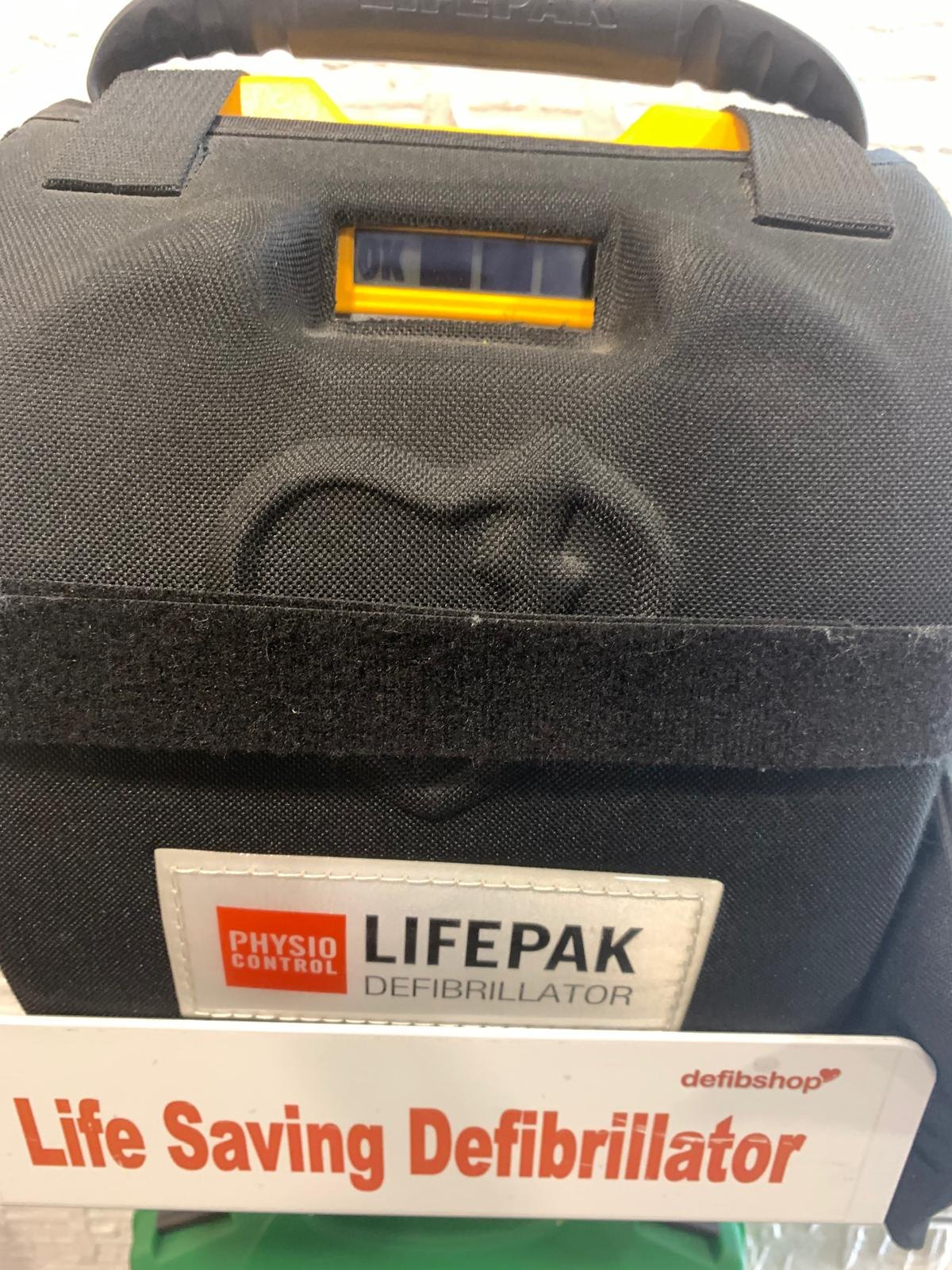
In hospital that is done with a defibrillator like the one shown here. For people at higher risk, a small version can be implanted under the skin so that it is always there.
Out in the community, public access defibrillators are kept in cabinets on walls, outside shops, village halls, schools and stations. They are made to be used by anyone. The machine talks you through it, and it will not shock a heart that does not need it.
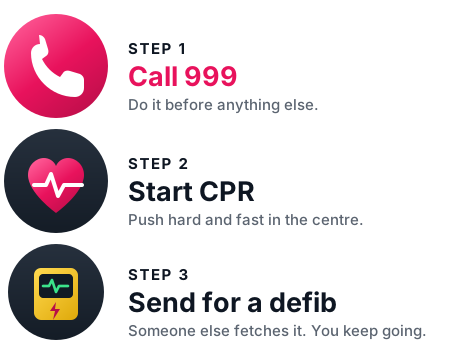
If someone collapses and is not breathing normally: call 999, start CPR, and send someone for the nearest defibrillator.
In your community
Know where your nearest one is
Most people walk past a defibrillator every week without noticing it. Knowing where yours is, before you ever need it, is one of the most useful things you can do. They are registered on The Circuit, the national defibrillator network, so ambulance services can direct callers to the nearest one. If your workplace, place of worship or community group has one, please make sure it is registered.
In an emergency
If a person collapses and is not breathing normally, call your local emergency number immediately, begin CPR, and send someone for the nearest defibrillator.