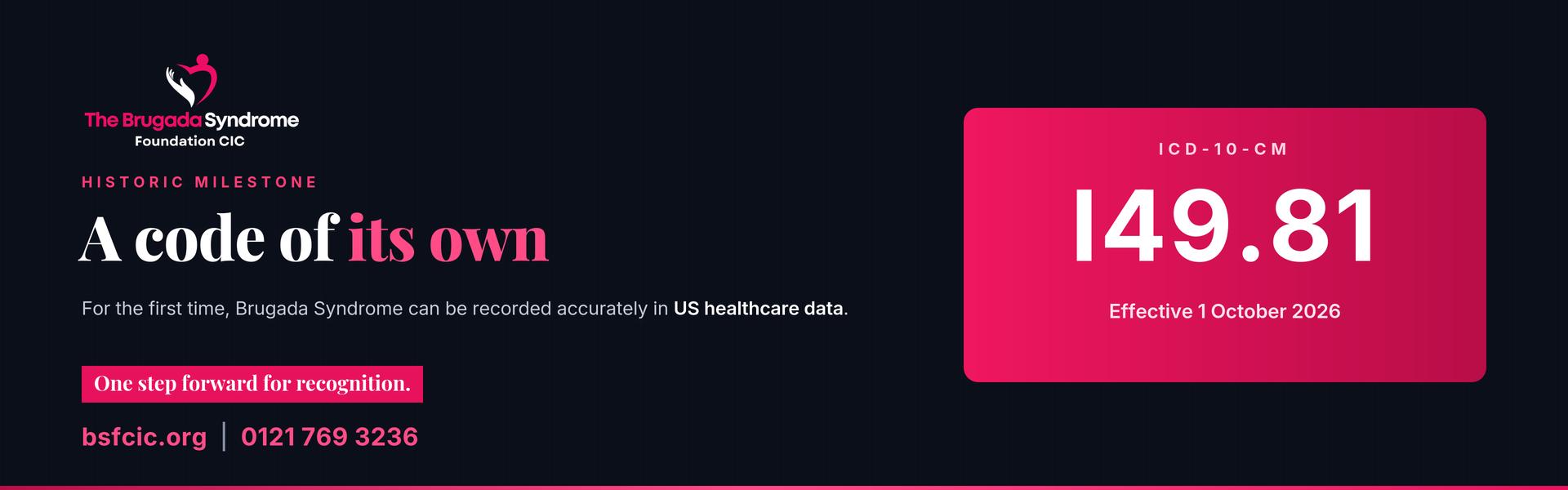
From 1 October 2026, Brugada Syndrome has its own dedicated code, ICD-10-CM I49.81, for the first time in the United States classification.
It is a small string of characters. It may turn out to be one of the more consequential things to happen to this condition in years.
Why a code matters
Every diagnosis recorded in a healthcare system is recorded as a code. Codes are how conditions are counted, how hospitals log them, how researchers find them, how health systems decide what deserves attention and funding.
Until now, Brugada Syndrome had no code of its own. It was grouped in with other arrhythmias under a broader heading, which meant it largely could not be separated out, counted, or followed.
A condition that cannot be counted tends to stay invisible. It is harder to track, harder to study, and harder to make the case for.
A dedicated code changes that. It means:
More accurate healthcare records, so a diagnosis is recorded as what it actually is
Better data collection, making it possible to understand how many people are affected and how they are cared for
Firmer ground for research, because researchers can finally identify the right patients in large datasets
Stronger recognition, in a system where being named is the first step to being prioritised
What this does and does not cover
ICD-10-CM is the clinical modification used in the United States, and its annual updates take effect on 1 October each year. This change applies there.
It does not, by itself, alter how Brugada Syndrome is coded in the UK or elsewhere. But classifications do not exist in isolation. Recognition in one major system builds the evidence base, and the argument, for recognition in others.
Our response
The Brugada Syndrome Foundation welcomes this milestone warmly.
For the families we work with, this is not an administrative detail. It is their condition being named properly, and counted properly, for the first time. Every family who has been told their condition is “too rare to study” understands exactly why that matters.
We remain committed to what we were founded to do: raising awareness, supporting affected families, and advancing the research that will change outcomes.
One step forward for recognition. One step forward for the Brugada community.